Course Reflection –Final Blog Post

This course really gives a unique overview of the approaches utilized by media literacy scholars. It introduced fundamental concepts that aided in the understanding of the coverage of various occurrences by mainstream media. These basic terms have helped me look at the media coverage and reporting in a critical eye and even allowed me to see beyond that stereotypical narrative that has people, who are not media literate, in an illusion. This course even allowed me to better understand the relationship between the media and its social, political and capitalistic contexts. The topics addressed were so diverse and so important that they enriched my insights of various media issues and dilemmas. I especially loved each theme of the critical papers as employing the concepts in different contexts and relating them to specific examples is what I needed to have a direct implementation of the course material; this even makes me remember them. I have also gained some digital skills which I always aimed to do, even though they were basic skills. Ultimately, it was way more than what I first expected this course to be and definitely was beneficial in terms of enhancing my media literacy skills.

I have to honestly say, in the beginning of the semester when we were asked to write the definition of media literacy, I just wrote what I understood from the reading. However, looking back at it today, I can safely say that media literacy cannot be explained through a definition. Being media literate is actually comprehending, interacting, analyzing the news that you are receiving and then looking at its concepts, its source, the political economy of its source… who is reporting? Which Tv channel? Who sponsors them? Who owns the infrastructure? Such questions are basically what come to my mind today when listening to the news. Being media literate is actually knowing the dangers of a one-sided story and the ability of the media to manipulate you into believing the side that serves its agenda – the agenda of those who own and fund it.

With no exaggeration, my whole view and perspective of the media and its relationship to society has changed after this course. It affected my engagement in the media through being able to stop the spread of false news, highlight biased occurrences, dive into the context of the media outlet and its coverage… In brief, far beyond my expectations and from now on, I will constantly look at courses with such learning outcomes.
In Class Exercise: Killing Gaza (2018)

This documentary is portraying the incidents in Gaza after several non-stop mass shootings by the Israeli military forces.

When a five day seize-fire was declared, the journalists behind this documentary went to Gaza and specifically to the “Shujaiyeh neighborhood” were most of the fire took place. Arriving there in the right place and in the right time is proactive witnessing. The latter serves the purpose of bearing witness rather than simply witnessing. This means that the video was shot strategically in order to pass a strong message to the targeted audience and the one’s who shot it were at the right place and in the right time. This documentary shows the Palestinian pain in a way that emphasizes how the Israeli forces are killing innocent, often young, civilians that do even know how to resist the shootings.

The video included different testimonies from parents and relatives of victims but they were not just simply telling the people a testimony. The striking difference is that the authors of the video included motion pictures embodying the testimony while the interviewed people were speaking. It was something you can hear and something you can see which indeed creates moral engagement. We now have their suffering imprinted in motion pictures while, before, I’d bet that when I am writing this (even though I just watched the documentary); I would have forgotten what happened. It sure is a way to engage people morally and ethically with what is actually happening rather than what is on the news.

Furthermore, an example on accidental witnessing would be when a volunteer in the International solidarity movement caught on camera the execution of ‘Salem’, an innocent civilian, that was helped by the volunteers to search for the body of his cousin. Salem was killed by a sniper and was left in his place as no one from the movement knew his identity; however, when the video was posted, it went viral and then his parents knew of his death.

I think the major impact of this video is the ability to leave a print in one’s mind of what is actually happening. The way it was shot and designed is so strategic that people cannot just witness what happened but they indeed were bearing witness. It has emphasized how the Israeli forces are killing innocent people without any mercy which is opposite to how some international media outlets show us. Seldom, we hear how Israelis leave those who are innocent alone and only are after resistance forces. Yet, this video stresses how this is not the case at all and reinforces it through the different real-life experiences and testimonies.

Class Exercise 4-Sound

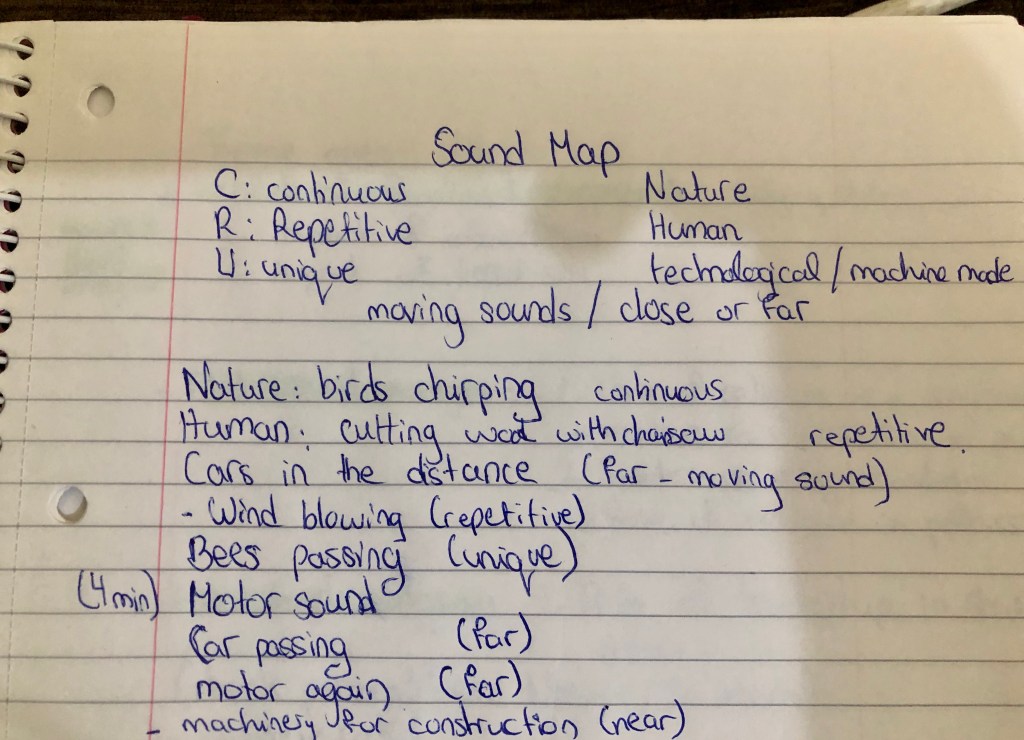
  • When listening again to the audio, I figured that the echo of my footsteps were heard most of the times. There is a time where a baby was crying in the background and the voice of some people were heard with the baby’s cry. Also, I missed noting the sound of a rooster that was repetitive at one point.
  • I think there was not a sound that is out of the ordinary, but the amount of cars that passed by in these 10 minutes were definitely more than what my parents would have heard in their childhood. Especially since the soundscape recorded, is in a village and not in a city.
  • Well, first off, if I had one memory left from my childhood, it would be memories of me and my cousins playing outside and having fun. Although, this is a time of quarantine, but even before that most of the kinds in the area do not play outside anymore. Also, the youngest of my cousins today do not at all play outside and instead they play together on digital devices i.e. virtually. So, if there is something missing in this soundscape that was prevalent in my childhood, it would be the cheers of children. Another example of a missing sound would be the horn of the ‘bagel seller’. We used wait impatiently for the bagel seller to come on his motorcycle while blowing his horn so that we know he arrived.
  • The most sound recorded would be the in the last minute of my Ambient Sound (10-11 min) since I was walking and there was a worker using a construction machine nearby.

Fake News About Coronavirus

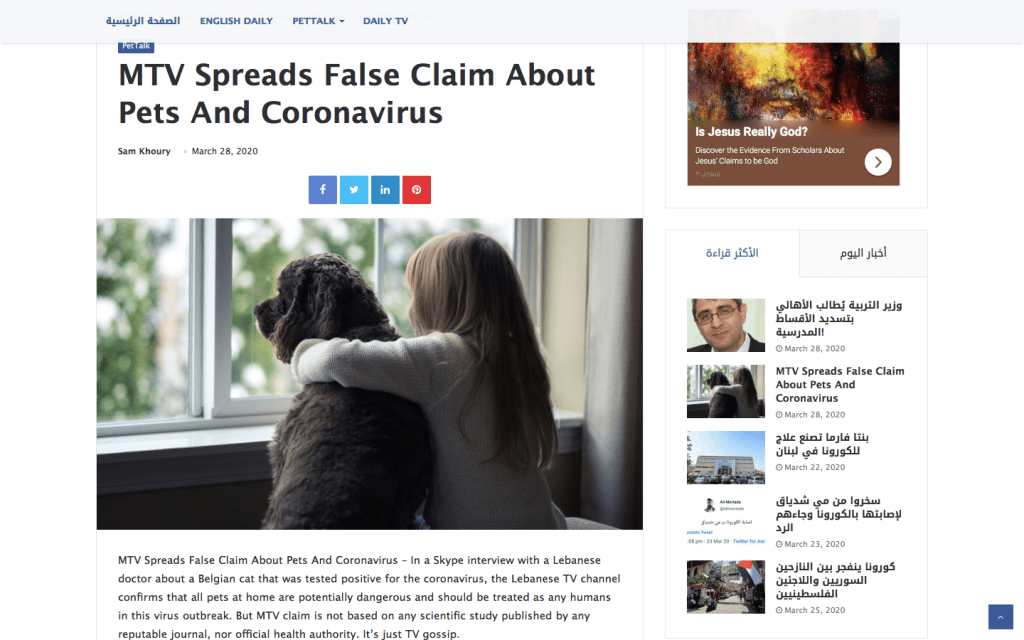
Covid-19, the corona virus’s scientific term, is indeed the dominating headline of all news websites, TV channels, and articles. However, the problem is that misinformation and disinformation are also accompanying these news articles. MTV Lebanon has had its take in this and some say this is for the purpose of gossip and attaining a scoop.

To explain what happened according to the above article. Mtv Lebanon called a doctor and asked him about the probability of animals getting infected by the corona virus –specifically about a Belgian cat that was reportedly infected. His reply was that yes they can transmit and get infected by Covid-19. He stressed on the need to treat animals the same as human beings in this matter. Although, the Lebanese “Veterinary Syndicate and the World Health Organization confirmed (scientifically) that pets cannot transmit the disease”. This resulted in a mass-abandonment of pets and disastrous treatment to animals for a while.

Referring to one doctor as a way to confirm such a critical assumption goes under the category of Pseudoscience. That is not getting enough reliable sources to confirm a certain claim just for the purpose of getting a scoop or attaining a political agenda.

Now what can be done to limit misinformation or disinformation is the following:

  • A law should be passed that forces Tv stations and Media owners to hire news editors responsible for highlighting disinformation that are circulating in the public sphere and to debunk them accordingly.
  • Tv stations might consider dedicating a certain section daily to emphasize the reliability and credibility of news articles.
  • General training through schools curricula and NGO campaigning about the importance of being media literate can be implemented so that the most social media users (young generation) can adopt media literacy skills.

References:

Khoury, S. (2020, March 28). MTV Spreads False Claim About Pets And Coronavirus. Retrieved from https://lebanesedaily.com/en/2020/03/28/mtv-spreads-false-claim-about-pets-and-coronavirus/

Kumanyika, C. (2018), Beyond Fake News, https://youtu.be/t10ErbfwG14?t=2925

Morgan, D. (2020, January 19). Infographic: Beyond Fake News – 10 Types of Misleading News – Sixteen Languages. Retrieved from https://eavi.eu/beyond-fake-news-10-types-misleading-info/

Cyber Resistance

The Zapatistas are a group of indigenous people originating from the jungles and mountains of southeastern Mexico. These people had a target to retrieve the land of their ancestors that was stolen by the rich and the colonialists. They knew that if they had control over what truly belongs to them, they can be sell-sufficient and improve the lives that they are suffering from. After 10 years of secretly planning for an attack against the Mexican government, the attack occurred and the Mexican government responded by force and military attacks. The Zapatistas referred to the media in order to make their voices heard and millions of people supported their movement. Protests in Mexico erupted and called for the basic rights that these indigenous people were calling for, to be recognized. A peace treaty was formed between the government and the group; yet, the government did not commit to the pact and kept on following and attacking them. That is why, the Zapatistas started relying on themselves in order to live a decent life. They united with the oppressed of the world and were open to all. They built their own schools, hospitals and even a local government (that was named the good government). In essence, the Zapatistas had a strong belief for a better world; a world free from injustice, inequality and autonomy. Till now they exist and are known for their net war against and E-tactics against the government.

Another form of cyber resistance, is found in Palestine. The internet and all ICT systems are owned by the West and pro-Israeli countries. Resistance forces in Palestine are always blocked whenever they want to make their voices heard. The internet is a monitored place and filtered words will always make way to a blockade against resistance forces.

In-class Activity: A Free Media Example

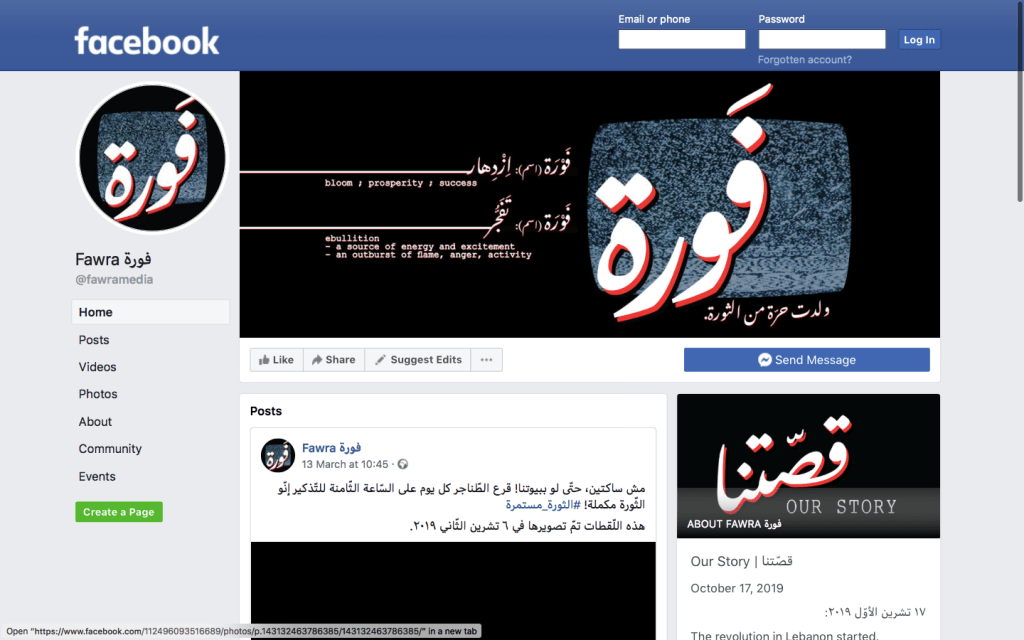
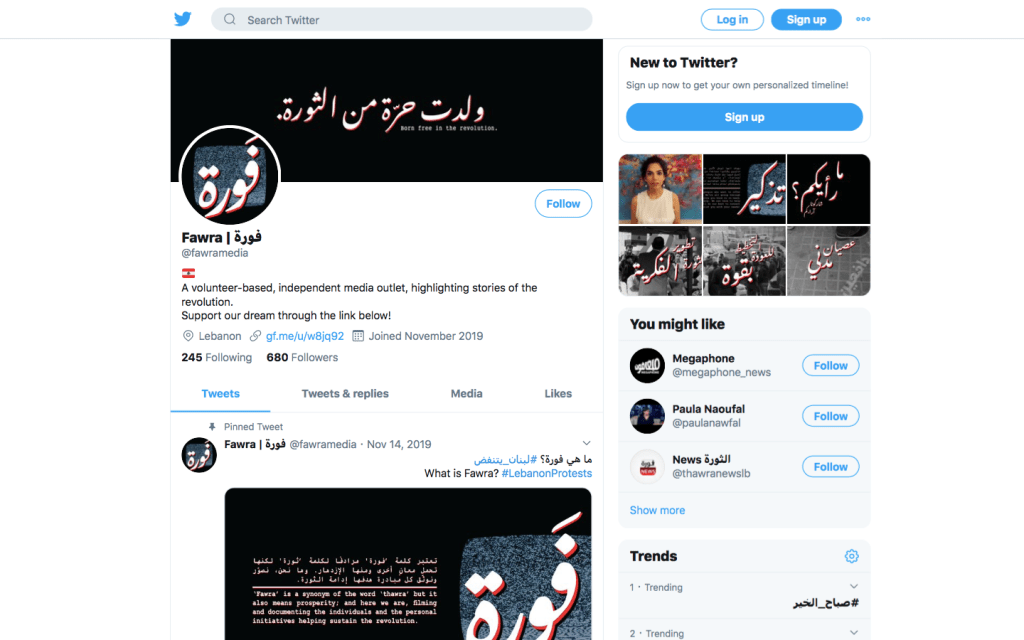
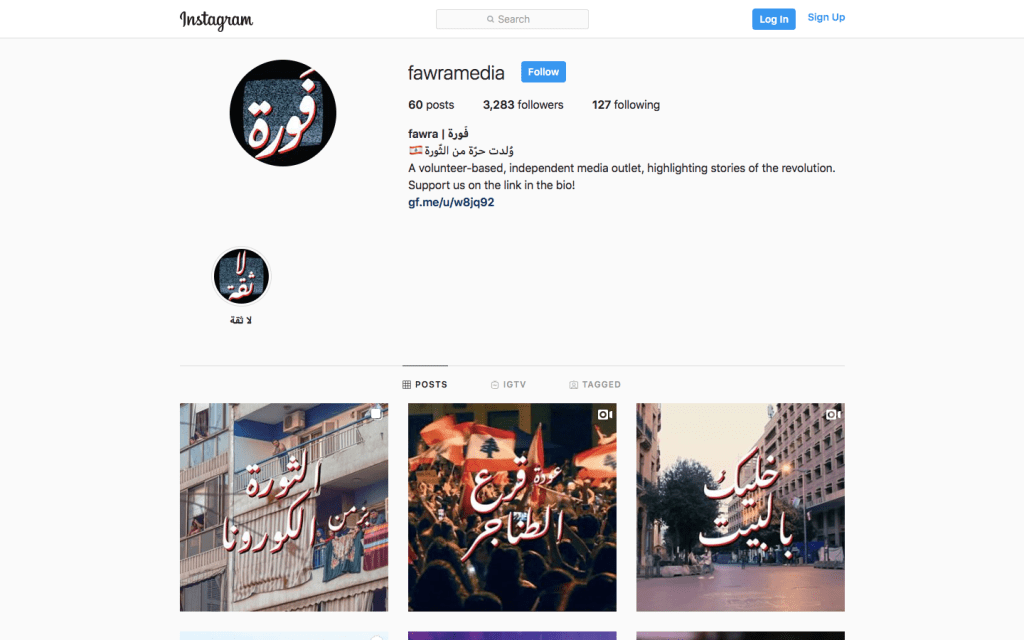
During the Lebanese Revolution, a lot of bias was portrayed on the Lebanese Tv stations as most, if not at all, are politically affiliated or/and owned by major political parties in Lebanon. In the midst of the chaos, there were some independent media outlets emerging that were with the revolution and wanted to portray a good representation of the movement. Most notably might me ‘Fawra’ media, it is an independent, secular and volunteer-based media outlet. Their mission was to open a media platform for all and address what is happening in the revolution freely. Undergraduate students,Lebanese journalists, filmmakers, photographers, artists and activists participated in this media outlet.

This means that Fawra was not owned by any major media conglomerate (a characteristic of Alternative media). It is non-commercial, amateurs can participate, and most importantly the news and information are coming from an alternative perspective.

However, it is not a free media platform since the infrastructure used to get to the masses does not belong to the public. Fawra connects with the people through major social media platforms as Instagram, Facebook, and Twitter which are all owned by US capitalists. Therefore, there is some limitations on their pages whereby the threat of being removed or deleted by owners of the infrastructure is always present.

Alternative or Independent Media

According to Forde (2011), alternative media encompasses various forms of media: community, grassroots, radical, citizens and independent. Alternative journalism engages their audience in the public debate which in turn creates a more active public instead of basic consumers of what ever being fed to them.

Alternative journalism can be practiced at any media venue (radio-Tv-commercial-non-commercial). However what makes it differ from the mainstream journalism is its refusal to operate on a major media ownership group. This is why its coverage of news tends to be different and genuine as it is not subjected to ownership power and domination. The alternative media journalism is unfiltered since also its journalists must not have any political affiliations or relationships.

Alternative journalism may range from a daily program or publication reaching a significant audience to an individually-produced blog or fanzine read by less than ten people Those working for the alternative media outlet could be amateurs or professionally trained journalists.

References: Forde, S. (2011). Chapter 1: Understanding alternative and ‘independent’ journalism [read excerpts]. In Challenging the News: The Journalism of Alternative and Community Media. New York: Palgrave Macmillan. Retrieved from: https://www.macmillanihe.com/resources/sample-chapters/9780230243569_sample.pdf

Prison Radio: In class activity

Prison radio is a multimedia independent production studio. It works with radio stations but it is not one; they produce content to the whole world through this platform and other broadcasting venues.

It is indeed a ‘free radio’ as we have mentioned in the previous blog post since it is not owned or controlled by the state. As this media platform challenges the police and prosecutorial practices to prevent further racism, gender discrimination and mass incarceration. It is ultimate goal is to give a voice to these imprisoned people in the public debate. The latter is a form of ‘active citizenship’ since it brings these voices to the public sphere instead of just interviewing or speaking with prisoners behind bars. This is important since the people probably know less about imprisonment conditions than any other justice system. (Anderson, 2013).

There other media practices than ‘prison radio in the US’ that involve inmates. Souverains Anonymes (Ontario, Canada) and Beyond the Bars (Melbourne, Australia) are examples of shows that direct broadcast live of inmates. On the other hand, there are shows as Prison Radio that offer pre-recorded interviews and workshops and these include: Off the Hour (Montreal, Canada), Jailbreak (Sydney, Australia), Sunday Night Request Show (Brisbane, Australia), and Prison Diaries (Minnesota, USA).

References: Anderson, H. (2013). Facilitating active citizenship: Participating in prisoners’ radio. Critical Studies in Media Communication, 30(4), 292-306.

Design a site like this with WordPress.com
Get started