The Radio as a Tool of Resistance

At the dawn of the 20th century, a turning point in the course of the media industry took place. At this time, the previously manufactured radio gained prevalence as a result of the ability to transmit radio signals across the world. However, it was in the post-World War I era (the colonial time) that radios were used for private and commercial use. The European countries had control over the radio industry and thus, the colonized world was subjected to more cultural and ideological domination through this type of media. The radio language was that of the colonial countries, filtered news were only entertained and nothing that contradicts the stance of European countries was accepted.

However, in the mid-20th century, a counter resistance emerged through the organization of local distribution news systems. Most notably, “The Voice of Algeria” was the first radio of non-colonial origin and served as being the real voice of the revolution. The local language was entertained and all the news was actually available to all which in turn created a unified nation against the colonial power. (Fanon, 1994)

Such rebellions grew and lead to a movement against state and corporate control over the broadcasting airwaves via structured policies (licenses and sanctions). This movement was known as the “Free Radio” and gained prevalence in the 1960s. It was seen in different countries as Fidel Castro’s Radio Rebele and Bolivia’s revolutionary radio stations… (Dunifer, 2010)

We can still see control over the freedom of speech, although it’s an international right and law. However, there is still till now movements that resist state control and aim at making their voices heard.

References:

In class exercise (2): How Do We Protect Ourselves From Facebook

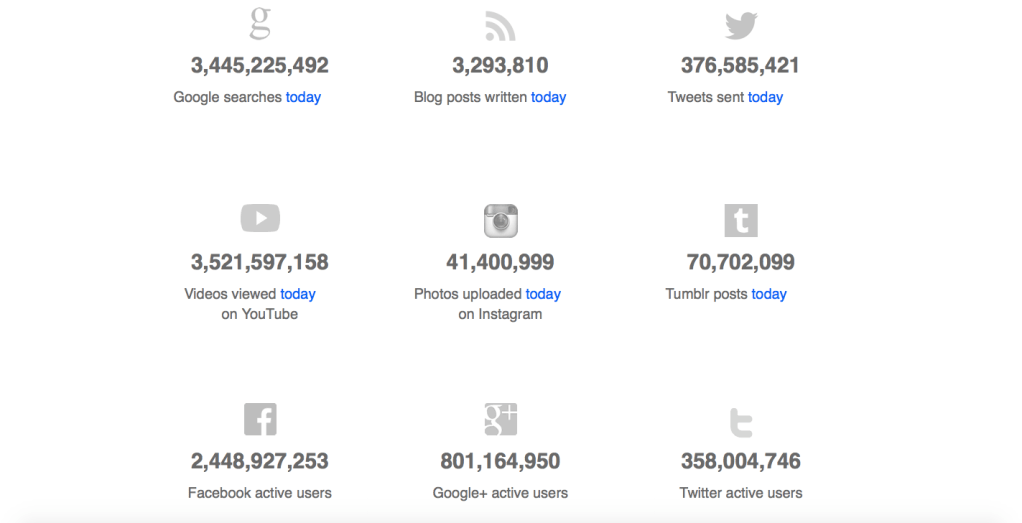
Internet Live Stats

Considering the latter numbers, one cannot but startle at the fast rate of increase pertaining to the usage of social media platforms. Approximately 2.5 billion users are using Facebook which means more than a quarter of the world have access to social media platforms. However, the problem is not with the usage of Facebook, but rather with its policies and functions that are mostly taken for granted. Facebook collects data ranging from private/personal information to date on relatives and your relationships. Nevertheless, with all the privacy policies that Facebook bombards its users with, there a lot of procedures that are innate qualities of the platform and thus, cannot be controlled. This is actually terrifying, any professional institution can through Facebook and its owned social media platforms (Instagram, WhatsApp, Messenger) gather as much information about active users as the CIA. The worst part is, that is based upon our ignorant consent. That is why, people need to be aware of such information that can threaten their privacy and private lifestyles.

For the latter to happen, the United States must legislate a law that specifies the right of Data Protection; this law exists in Europe and aids in protecting its citizens from the dangers of media platforms. Also, reading the privacy terms and conditions should be a mandatory aspect prior to using such platforms in order to help people become aware of the aforementioned threats. Additionally, since most users are of new generations, integrating lessons on social media in their academic curriculum is a necessity to help them navigate attentively on what they spend most of their time on nowadays.

References: Internet Live Stats – Internet Usage & Social Media Statistics. (n.d.). Retrieved from https://www.internetlivestats.com/

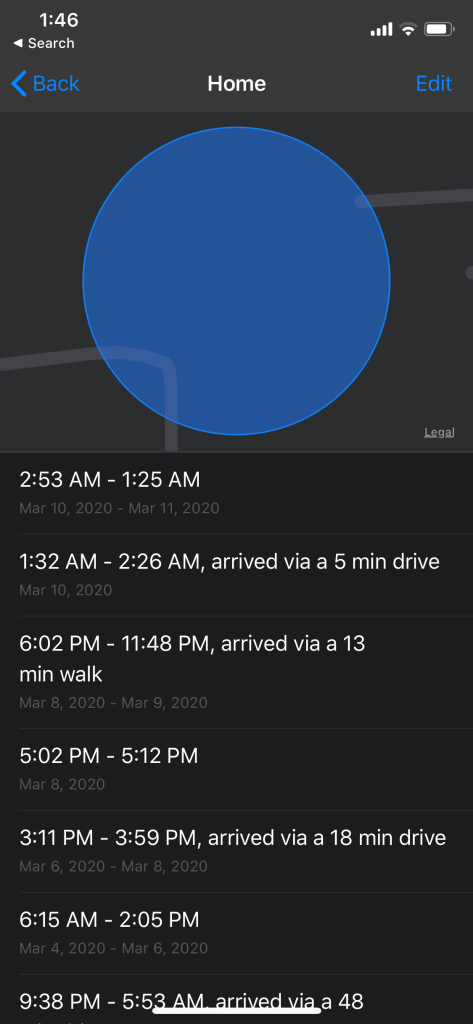
In-class exercise: Digital Shadow

I was surprised to learn the registered locations on my phone; it is as if every movement is tracked and known to all. Day by Day, our digital shadow is growing and without noticing who is being associated to it and whom am I giving my data too. This digital shadow can help major corporations to spy on us and track whom ever is related to us without our consent. It is how it is and we should refuse allowing it.

Lebanese Media Conglomerates

It all started with the Lebanese Television (TL) which was supposedly a TV station serving the Lebanese people and Lebanon solely. This industry widely dominated and lead to the development of another television corporation known as Tele-orient. However, both companies received financial support at one point from the West. TL was supported by the French media company “SOFIRAD” and Tele-orient was supported by ABC in America. This lead to further integration and dominance of the western culture. However, it also reflected ‘ownership’ which is one of the concepts mentioned by Fuch (2016); in this context, ownership reflects the control of the private sector on the media. In turn, this leads to the exploitation of the content published in favor of certain political agendas.

Moreover, the media sector in Lebanon continued on gaining more profit till the Lebanese civil war. The Lebanese civil war lead to the loss in the power of the media industry and thus the fall its profit. Afterwards, came the Taif Agreement that ended the civil war and created a new sectarian Lebanon. Not only did it plant the religious and sectarian values in the heads of civilians but also within the media. Licences were given only to post civil war leaders. This also serves the ruling elite and changed the course of media till today. TL and Tele-orient joined and became one but still remain really weak in terms of technology and innovation.

The major television channels today mostly contain a political background and serve religions. Nothing that contradicts the policies and image of the owners of the Tv station can be aired. On the other hand, they all have one capitalist trait in common – the thirst of profit. Thus, you will see that all of them tend to treat the audience as a commodity through airing shows that talk to instincts of people rather than their minds. (Artz & Smythe, 2008)

References: Fuchs, C. (2016). Introduction, read pp. 1-5 only. In Reading Marx In The Information Age: A Media and Communication Studies Perspective on Capital Volume 1. New York: Routledge. Retrieved from: http://fuchs.uti.at/wp-content/uploads/introduction.pdf

Artz, L. (2008). Media Relations and Media Product: Audience Commodity (read excerpts). Democratic Communiqué, 22(1): 60–74. Retrieved from: http://journals.fcla.edu/demcom/article/view/76591

Surveillance Sublime

Ever since the emergence of the social media and commercial processes began. These platforms collect information on active users from all around the world and the government, companies and individuals can access these data. Additionally, private-public partnerships are making their way which in turn threatens the peoples information on these platforms. It is a complex relationship between both the users and the identifiers.

These platforms are also programmed to identify certain “keywords” and thus when a any word in this list pops out any where in any page. It automatically gets checked and might be either reported or deleted by the company of the social platform being used. That is why we will find major attacks on Palestinian activists, and at times attacks on people with gay rights… That is why human right defenders see this website as a major platform to call out for what they believe in although at various times it limits democracy and liberty.

References:

• Ball, K., and Snider, L. (2013). The surveillance-industrial complex: towards a political economy of surveillance? (excerpt, read p. 1-5 only, until “the volume” heading). In K. Ball and L. Snider (eds.), The Surveillance-Industrial Complex: A political economy of surveillance. Retrieved from: https://www.book2look.com/embed/9781136206979

• Hache, A., and Jansen, F. (2018, July 9). Privacy, Surveillance and Data Tracking: Why Does it Matter for Human Rights Defenders? In Free media: issues, challenges and proposals (online publication). Retrieved from: https://www.ritimo.org/Privacy- Surveillance-and-Data-Tracking-Why-Does-it-Matter-for-Human-Rights

Surveillance Forms on Facebook

The first type of surveillance is the ‘commercial surveillance’ where facebook can through its advertising system know all the preferences and moves of any active individual. Therefore, this system can be exploited by advertisers in general as they will know exactly what their clients want. For instance, most of the times, I tend to look at a make-up page for a while and then the other day all the recommended pages will be about make up. Another advantage of this surveillance goes for the government as any move conducted on Facebook is stored in the application and the government then can detect what individuals write, their preferences, their perspectives, their friends and enemies.

Another type of surveillance might be the other services that connect with Facebook and are not owned by the company. For instance, Spotify, the music application, connects with Facebook through the One graph service. This makes the Facebook generate more information about active users on both Spotify and Facebook, thus more surveillance. Also the concentration of its power is the main factor in creating more personalized pages. It is considered the most rich application after google to improve.

There is also another form of surveillance that comes from sources other than Facebook. Odeh (2018) conducted a field research on Palestinian women’s experience with gender-based violence on social media. Her results show that most of the Palestinian women report constant intervention of family members in their freedom of speech and expression. Therefore, patriarchal authority is still dominating not only in reality but also on virtual platforms which is what some females referred to as the “Surveillance Tower”.

References:

Concentrated Ownership of the Media in relation to Politics

Ever since the boom of globalization and the media industry started growing bigger and wider. To start off, initiating a media conglomerate requires a huge capital and a governmental license. Therefore, whoever would like to start his own company must be rich and have a lot of connections, often with the ruling class. That is the case in the Middle East region as the so-called ‘Media Giants’ are mostly funded by the Gulf capital, owned by the ruling elite, and is closely censored by the governments of the Gulf. That is why the media industry cannot, but be related to politics. Nothing that defies the governments beliefs, values or policies, is allowed to be aired on any of the media companies in the region. In sum, most of the companies are related to the ruling elite, governmental members or some rich people that have good connections and that’s what capitalistic media is. “Those who own the means of production, have control over the means of mental production” (Karl Marx, 1848) which in this case is the media.

When applying the latter on Lebanon we will find that after the Taif accord in the 1990s, private television broadcasting licenses were given on the basis of equal representation of all sects in the Lebanese media. As a result, the Lebanese media industry was controlled by post-war leaders and today is ruled by ex-warlords and the new emerging class o f business men with major political affiliations.

As for the term ‘militainment’, it is taking advantage of the occurrence of wars or military fights via commercializing and advertising on Televisions shows. This occurs by attracting more viewers and thus more profit. Also it can increase sells for the private benefits that the owners want to obtain by attracting viewers.

References:

Capitalism: ‘A Deceitful Joke’

Defining capitalism is a hard task as it has several meanings depending on the contexts used. We have media capitalism, trade capitalism, political capitalism… However, a major characteristic of capitalism, one that unites all, is the domination of private enterprise, ownership and profit-oriented corporations. Capitalism is not solely an economic startegy that organizes the market, it is more of an ideology, excuse for capitalists to dominate and take control of the market. It is a deceitful platform that calls for ultimate freedom when it gives none. The one’s who are in control of the means of production are the only ones that have this freedom since they are the ones making the rules, the economic strategies, the educational, moral system. Of course, the latter are only made if they are in line with their own interests -the elite-; yet, you’ll always seem them calling for humanitarianism. Ironically, this is due to their domination as well on the media, you think that anything that really benefits the people rather than the manifacturing company, gets advertised or aired on TV shows? Consequently, one of the most capitalistic centers today tends to be the communications and media. Those who have the money and the power are the ones that get to the top. Meritocracy is a LIE, and exceptions are the ones that make it. However the system is made to leave the poor, impoverished and the rich, wealthier.

As previously mentioned, there is capitalist communications which also portrays the same concept of domination; however, the elite that control the media tend to be political rulers. Ever since the mid 20th century and the media became more of a realm for the discussion of politics, anything that concerns politics was dominated by journalists and later on in the media. Today, the ruling powers are the mouthing pieces of the media, anything that is against them can be directly shut down or raided by police men. Because this is what Capitalism is: An excuse for the ruling power to manipulate the people and keep them unaware of this manipulation. I’ll leave you with three questions to think about:

When was the last time a major power as the president, the prime minister or the parlimentarians publicly humiliated or exposed?

How much do we know of the deals that happen concerning refugees and war countries?

How is Israel a country and not Palestine?

References:

Fuchs, C. (2016). Introduction, read pp. 1-5 only. In Reading Marx In The Information Age: A Media and Communication Studies Perspective on Capital Volume 1. New York:
Routledge. Retrieved from: http://fuchs.uti.at/wp-content/uploads/introduction.pdf

Artz, L. (2008). Media Relations and Media Product: Audience Commodity (read excerpts). Democratic Communiqué, 22(1): 60–74. Retrieved from: http://journals.fcla.edu/demcom/article/view/76591

Media Discourse on Sexuality

It is undeniable that the Taif Agreement between the post-war leaders has affected the whole order of the Lebanese society. It ended war, but it most certainly did not do a good job at creating this new order. The Taif Agreement aimed for a secular lebanon but did not put any time frame to do so; consequently, the governance, employment and even the media were divided based on sectarian equality.

Furthermore, since most of the sects are either conservative politically or religiously; the common discourse associated to the media and to the public generally, should be always in line with religious and conservative backgrounds.

This brings up the concept of Homophobia into the light. From the 1990s and the media discourse on sexuality was homophobic as it was supported by the law adopted from the French Colonial era and by all sects and religions. However according to Mandour (2013), in 2012 and 2013, two major events regarding sexuality has changed the maintained discourse on sexuality by the media.

The first event was a raid of the Crown Plaza -gay cinema- by policemen due to a TV show (Enta 7orr) hosted Lebanese journalist (Joe Maalouf). Joe went undercover and convinced two gay men in this place to accompany him in the bathroom and in the meantime he secretly videotaped them. What happened next was that he aired it live and urged policemen to stop these ‘abnormal acts’.

This resulted in a huge media backlash towards MTV and the journalist; which consequently lead to a prevention to the ‘anal test’ conducted on the 36 detainees of the Crown Plaza and good introduction by the LBCI tv station that implicitly stated that this against human rights and the lebanese government should work on the real problems (electricity, garbage..)

Another event happened in 2013 where policemen raided the gay bar GHOST in Dekwaneh and captured certain individuals again. They also conducted the previously prevented ‘anal test’ and executed different violent acts towards the detainees. Once again, LBCI brought this too light and criticized these brutal acts.

As a result, a major shift in the term homophobia was witnessed and now tv shows aim more at attracting audience for profit purposes which in turn obliges the media to change its discourse on sexuality. Especially since the new generation fosters a warmer welcome to all colors, races, sexualities and genders than those of the civil war.

References:

Mandour, S. (2013). Potential Change in Media Discourse on Sexuality in Lebanon:
“Cinema Plaza” and Beyond [Reuters Institute Fellow’s Paper]. Retrieved from:
https://reutersinstitute.politics.ox.ac.uk/our-research/potential-change-media-discoursesexuality-lebanon-cinema-plaza-and-beyond

Design a site like this with WordPress.com
Get started