Patriarchy in Arab Media

Patriarchy is something that we see everyday in our Arab society and sometimes without even noticing, in an indirect manner. Starting with the fact that males still get more privileges than women in the workplace, in their bodies, legal studies…

Patriarchy is not just a word, it became a social construct. Women are housewives, homemakers and men are the ones who are responsible for bread-winning, providing money and a living for his family. It is how it is and women tend to accept it as a reality especially in he Arab world. Women in this region tend to be subordinate to men because they are afraid of being something else and it is literally portrayed in our environment everywhere.

For example, in the media and in video clips, we tend to be advertised as objects or as sexualized beings, there just for the sake of fulfilling what every man wants and his desires

Zaatari(2015), refers to that in his article that scrutinized the popular TV show ‘Bab-EL-Hara”. The Syrian show reflects male dominance as its best; men tend to be violent, aggressive towards their wives and the women in return should obey and be subordinate.

Women cannot go outside without covering their faces and this is said to protect the ‘honor’ of heir family and if she’s married; the honor of her husband. We even take it for granted as being normal. Then again the quote “Women are women, and men are men” comes back to life. BaB-el Hara is still airing and still has the notion of patriarchy as its theme but Im really glad its way less as women tend to leave their houses now and fight along men but in limited manne.

References:

White of their eyes

In “The Whites Of Their Eyes” author Stuart Hall discusses ideologies, specifically racist ideologies and the role of media in producing and reproducing these ideologies. He begins by intricately explaining ideologies in a general sense and points out three main points not to be overlooked while studying ideologies.
First, Ideologies are not merely made up of concrete concepts, but rather made up of “liquid” concepts, that take the shape of whatever situation they’re applied in. To simplify, ideologies are moderated to apply to the present conditions. An ideology is twisted and applied to a set of meanings, and the same ideology can be applied to a different set of meanings.
Second, ideologies are not statements made by individuals, ideologies are rather what dictates individuals’ statements, which is perceived by the surrounding, making the practice of transforming ideologies a collective process rather than an individual one.This process is also majorly an unconscious process, which makes ideologies prone to “naturalization.” Naturalizing is what weakens an ideology, by brushing it off as something that is “common sense” and taking it for granted based on the Nature.
Third, ideologies are expressed in people’s discourse, and appear to be authentic to the author/speaker, that is not due to the ideology stemming from the individual’s most pure, honest and authentic self, but rather due to the ideology reflecting to the individual an identifiable point, to which they relate to. Ideologies function by connecting with individuals and pin-pointing a reflection of how their situation relates to this ideology.

References:

The Aesthetics of the Yarmouk Photo

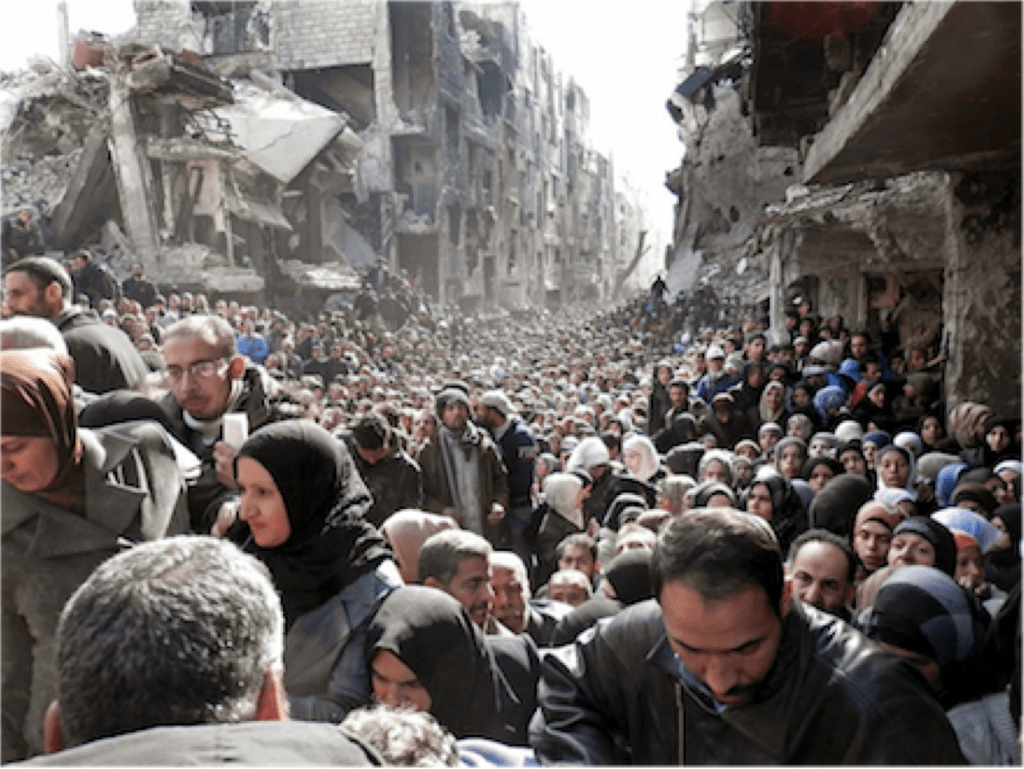
The Yarmouk photograph was released by the United Nations agency for Palestinian refugees and illustrates an instance where over 18,000 refugees were waiting in line to get some food from UN workers. Kandutsch (2015) was struck by this published image and tried to understand the meaning behind it. He proposed that it might be captured to trigger the audiences’ moral conscience or for the purpose of aesthetics or punctum.

Starting with the last notion, the author disagreed that it might be serving the claim of punctum. This term is really important in photojournalism where photographers tend to focus on rare details that will attract the consumers attention. However, Kandutsch (2015) believed that this photograph may make people recall a private experience when this picture should catch the attention of the global community.

The author therefore preferred to state that this picture follows the ‘absorption’ and ‘facingness’ norms of photojournalism. The former describes pictures that present a freezing intsant of action that’s being done by the captured subjects, without them being aware of the shot. The latter, by contrast, refers to the characteristics of the photo in general and not the subject of it; therefore, the way the photo is captured is depicted by facingness.

On another hand, Share (2018) claims that photojournalism can never be objective as each decision while taking the photograph, whether it is the angle, the location, the caption, or the subject, are all considered to be subjective. I, completely agree that jornalists can never be objective since there’s always indirect bias in articles even if they were news articles. It could be through the pictures taken, the headlines, the wordchoice, or even the sources.

References: Share, J. (n.d.). The Camera Always Lies: Breaking the Myth of Journalistic Objectivity. Retrieved from: https://www.medialit.org/reading-room/camera-always-lies

Kandutsch, C. (2015). A Yarmouk Photograph. In CTheory. Retrieved from: http://ctheory.net/ctheory_wp/a-yarmouk-photograph/

In class project

The Times of Israel
ARABNEWS

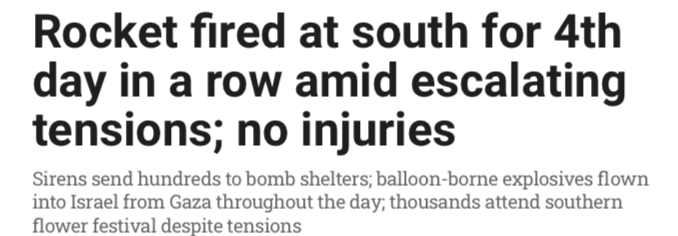
The latter headlines portray the recent Gaza bombing by two different sources; one from the Arab region and one from Israel. The bias in the word choice of the headlines and the headline itself is clear since in the 1st headline, there is an emphasis on the ‘no injuries’ aspect of the event while in the second one there’s emphasis on Israel initiating the attack, yet later on in the article they mentioned that there are ‘no casualities’.

Moreover, as publicly known the Israeli journalists portray palestinians as the ‘common enemy’ therefore the selection was biased towards writing about the attack launched by ‘Hamas’; on the other hand, Arab news has shed light on the attack launched by ‘Israeli warplanes’. Bias by selection, common enemy and placement

References: Afp. (2020, February 1). Israeli warplanes hit Hamas in Gaza after border fire. Retrieved from https://www.arabnews.com/node/1621381/middle-east

 JUDAH ARI GROSS, TOI STAFF, The Times of Israel, 2020

The Four Habits Used in US Media Coverage

Moeller (1999) has believed that there are four habits used by news writers anchors when portraying a certain crisis. These habits include: “putting forward a formulaic chronology of events, employing a sensationalized and exaggerated use of language, referencing certain metaphors and imagery that resonate with Americans and emphasizing an American connection.”

When it comes to the Palestinian war in Gaza, the western and middle eastern media each has a different story as the events in Palestine are portrayed according to the side (Israeli or Palestinian) each country advocates. (Battah, 2009)

According to Moeller (1999), the Americans like to specify certain groups of the international community as good or bad which in turn explains the American media coverage of the incidents in occupied Palestine. America has a clear stance of advocating Israel over Palestine in their war which is also evident by the recent so-called “Deal of the Century” between America and Israel (Trump, 2019). Therefore, the American media coverage is always portraying the war incindents in favor of Israel. Why? Since by reference to (Moeller, 1999), the media plays a huge role in creating a certain image in the minds of their audience that makes them eventually fail to differentiate between facts and the sterotypical charcterization of a certain group of people. This is the first habit Moeller speaks off and when applied on the US Gaza war analysis of Battah (2009), it’s usage is evident by his reference to the cover page on the Washington Post which contains a picture of a Palestenian woman that has lost her five children and an equally sized photo of an Israeli woman that is relatively unharmed and solely crying.

To further portray the Israeli people as victims that are equally harmed, the American news writers tend to exaggerate certain incidents in their favor indirectly. The latter is through the usage of ‘Sensationalized Language’ -the second habit. This is also clear in Battah’s analysis as the American media rarely states the death toll of Palestinians in attacks caused by Israeli millitants; however, when Hamas is the one attacking the approach would be quite different and exaggerated to show the ‘real’ victims.

The third and fourth habits speak of a comparison between tragedies and the American coverage of incidents respectively. When it comes to the war in Gaza, the pain endured by Palestinians is always compared to the damage afflicted on Israelis eventhough the damage might be for one emotional, psychological and for the other physical as demolishing buildings and infrastructure. In addition, when comparing the Arab media coverage and American one in Gaza, the difference is staggering. For instance, the American news anchors might give it one or two minutes of their time, portray snippets of some videos that are rarely clear, and do not even interview Palestinian victims. By contrast, you will find Arab T.V stations having full time coverage of all attacks, interviewing victims of both sides, and giving time for both the Palestinian and Israeli officials. (Battah, 2009)

Finally I would like to end my blog with a quote which is in Arabic, yet, exactly portrays the aforementioned situation and the currently witnessed one:

“أعطني إعلاماً بلا ضمير أعطيك شعباً بلا وعي”

References: Moeller, S. (1999). Four Habits of International News Reporting (read pages 1-6 only): In Compassion fatigue. London: Routledge.https://frameworksinstitute.org/assets/files/PDF_GII/four_habits_of_news_reporting.pdf

Battah, H. (2009): In the U.S., Gaza is a Different War. Al-Jazeera. Retrieved from:https://www.aljazeera.com/focus/war_on_gaza/2009/01/20091585448204690.html
The Propaganda Model

Herman and Chomsky (1998) have believed that media outlets tend to transmit news that are in line with the values and beliefs of media entities and their partners. The authors have developed a model that sheds light on different factors that help integrate manipulated public information into the minds of people through propaganda. These factors include:

  1. The size, concentrated ownership, and profit orientation of mass media firms which highlights the centralization of mass media entities in the hands of a few elites. The latter is due to the large investments and costs needed to start such a business which in turn makes the wealthy dominate this sector. This concentrated ownership leads to shaping information as per the interests of the partnering corporations, the advertising companies and the wealthy owners. In addition, media outlets also need licenses and legal documents for legitimacy and as a result, the government sometimes is capable of intervening in the transmission of news across the public due to the media’s technical dependency on them.
  2. Advertising: For all media outlets, advertising is considered a major funding mechanism that helps in increasing their income and reducing their costs of production. This factor can also help in filtering the news since anything played or broadcasted that is not in line with the interests of advertisement providers may lead to a contract withdrawal and thus a risk of damaging the organization’s reputation. For example
  3. Source: To remain credible and avoid any kind of criticism, media organizations tend to be objective by relying on credible sources or its equivalent. However, sometimes having wealth and power can allow certain sources to manipulate the mass media into following a special agenda and into inducing change in their media policies.
  4. Flak: refers to the negative, damaging reactions formed by the local, national or international community towards a certain published statement or broadcasted programme by any media entity. However, when formed on an international scale, this would greatly damage the reputation of the organization attacked; notably, the sources creating such criticism must have great power to produce large scale flak. That’s why the media will always try to avoid statements which may bring flak and will always filter items that may cause the latter -prior to their publishing.
  5. The common enemy: as evident by the aforementioned filters, the media is controlled by a minority of elites; as a result, anything concerning communism is always portrayed drastically corrupt and immoral. Communism threatened this minority rule as it spread consciousness on the ideological and ethical domination of the ruling class in every epoch and its indirect control of the masses’ belief and value systems. Therefore, any item that portrayed the good side of communism was seen as a threat that must be reformed to match the benefits of the corporation’s owner(s).

Example on the fourth filter: “Flak”

Murdering journalists for doing their work: The worst type of flak might be the physical damage done to journalists for trying to portray the truth in its exact details. A lot of countries tend to voice the importance of freedom of speech on the news and on t.v shows; however, when it comes to the practical work, journalists suffer from a lot of constraints when trying to portray the event as it is. As previously mentioned, the worst type might be physically damaging journalists. For instance, Israeli soldiers target the Palestinian press when trying to cover the protests and according to the investigative committee of the UN’s Human Rights Council (2019), 39 Palestinian journalists were wounded by sniper shots and two photographers were found dead at the Gaza fence in 2018.

References:

Herman, E. S., & Chomsky, N. (1988). A Propaganda Model [read excerpts]. Excerpted
from Manufacturing consent: The political economy of the mass media (1st ed.). New
York, N.Y: Pantheon Books. Retrieved from: https://chomsky.info/consent01/

Omachonu, J. O., & Schultz, D. (n.d.). Media Concentration. Retrieved from https://www.mtsu.edu/first-amendment/article/1127/media-concentration

Design a site like this with WordPress.com
Get started